“walk with a tortoise”
The Salt PathThe expression “walk with a tortoise” links an early, puzzling prediction to an actual encounter near the end of Ray and Moth’s long walk. First taken metaphorically, it returns as a literal sighting more than a year later, when a man is walking a tortoise on a customized dog harness. The phrase’s movement from joke to apparent fulfillment gives it a peculiar force: it is at once an absurd detail of the trail, a measure of elapsed time and an invitation to consider whether the journey has brought the walkers back to a place they could not yet imagine.
An uncertain prediction
Early in the walk from Minehead, Ray and Moth were already learning that the route’s printed descriptions could not prepare them for its bodily reality. The guidebook’s claim that the path “drifts a little inland and uphill” seemed comically inadequate on an excruciatingly steep zigzag through the woods. Their progress depended on stopping, breathing and reassessing the landscape rather than trusting a neat verbal description. In that setting, a prediction about walking with a tortoise could also be received as figurative language: a phrase whose meaning was not yet clear, set against the practical, unpredictable business of putting one foot in front of another.
By the time the phrase comes up again beside Fleet Lagoon, the walkers are looking at more than a hundred swans in the water. The scene is ordinary in its details—flat ground, dusty arable land and a steady walking rhythm—but the swans seem to make the day increasingly surreal. One of them remarks, “I thought he meant metaphorically, as in: ‘you’ll walk with a tortoise’; I wasn’t expecting actual swans.” The line exposes the misunderstanding without resolving the prediction. The swans are not its fulfillment; instead, their unexpected presence makes the remembered phrase newly vivid and prepares the reader for a more literal encounter still to come.
The phrase made literal
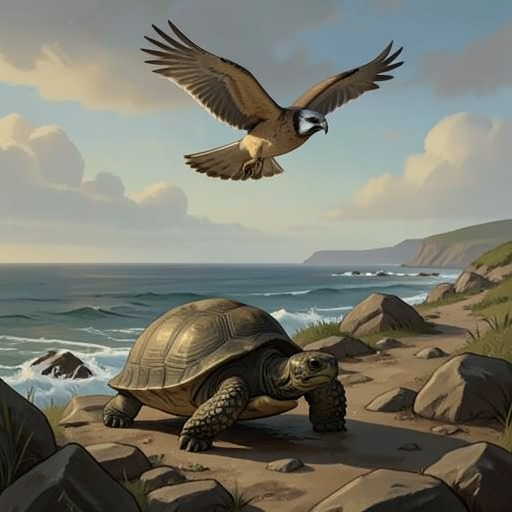
That encounter occurs more than a year after the walkers first heard the prediction, on a later stretch of their journey. As they approach what looks like a rock, they realize it is a tortoise. It is attached to a customized dog harness, taking bites of grass and herby undergrowth before moving on, one slow step at a time. The episode supplies the concrete image missing from the earlier allusion: not a metaphorical companion, but an animal being walked along the path.
The exchange keeps the scene grounded in comic everydayness. Ray greets the man and his tortoise; asked what he is doing with her, he answers, “I’m taking her for a walk.” The walkers observe that a lead seems unnecessary for an animal unlikely to run away quickly. Then, in unison, they take another step. Their synchronized movement is small, but it places them inside the scene rather than outside it as spectators: the tortoise’s pace and their own forward motion briefly meet on the same path.
Once they have climbed the next headland, Ray says, “Don’t even try to tell me that was a coincidence.” The line does not prove that the prediction had supernatural force. Instead, it captures the emotional pressure of seeing an obscure phrase recur in such an exact and improbable form after so much time on the trail. Their laughter follows, while the landscape below supplies the next landmarks: Lantivet Bay and the familiar Pencarrow Head. The tortoise becomes memorable not because it explains the journey, but because its arrival makes the journey’s scattered moments feel briefly connected.
A phrase carried by the journey
The episode gains meaning from the way walking has already shaped Ray’s attention. In the early stages, the route is registered through strain and sudden exhilaration: legs, hips and shoulders ache on the climb, while a rocky path, wind and sea open into vertigo and freedom. Later, the repeated effort of rising and falling between gorse and stone settles into a rhythm. Hunger and pain soften into ache and thirst; the passing views mark the miles behind, while the path ahead keeps turning towards another corner. Walking is at once physical labor and a way of noticing how place changes with movement.
That rhythm also becomes a form of endurance during crisis. Ray describes the walk as a meditation in which each step has its own moment of power or failure, and each climb out of a combe becomes a victory. The tortoise’s slow progress resonates with that repeated forward motion, but the text does not reduce the animal to a simple emblem. Its literal, peculiar presence matters: the walkers meet an actual creature in an unexpected encounter, and only afterward recognize how closely it matches the phrase they had set aside.
The walk’s meaning shifts as well. At the southernmost point, Ray reflects that the couple will not return to their former home and that a strip of path has become home in its place. The landscape no longer seems merely an empty country they must cross; Ray describes a growing acceptance of being part of the elements without needing to own land. Later, back on the path at Old Harry Rocks, the familiar pull of wind, grass and salt makes the return feel right, even as the couple faces uncertain practical choices. Against this longer change, “walk with a tortoise” is neither a solution nor a plan. It is one more unexpected occurrence through which the walkers experience a world that cannot be made entirely predictable.
Return, coincidence and ending
The tortoise appears close to the conclusion of the homeless trail, when the end is both desired and difficult to approach. Ray and Moth walk painfully slowly, stopping to look around, excited to arrive but reluctant for the journey to be over. After they cross Pencarrow Head, they sit overlooking Lantic Bay, share the last of a pack of wine gums and watch a peregrine follow the cliff line. The walk has ended, but its final encounter enlarges the sense of return rather than closing the story into a simple destination.
A figure emerges from the gorse wearing the same coat and hat as a year earlier and carrying the same stick. He says that “She’s been back a week now,” that she had gone on the same day as the walkers the previous year, and that she had told everyone they were coming back. He calls it a sign. The statement leaves the relation between prediction, return and sign unexplained; its force comes from being spoken at the point where the couple’s long route has brought them back to a familiar headland. The tortoise episode thus becomes more than a one-off joke: the phrase first seems fanciful, then becomes literal, and finally belongs to a pattern of departure and return that the book allows to remain uncanny without declaring it miraculous.
The expression’s lasting significance lies in that unresolved balance. The tortoise is real, the encounter is concrete, and the walkers’ surprise is unmistakable; what the event means beyond that remains open. Alongside the exhausting climbs, changing seasons and choices about where to live, the phrase records how a journey can accumulate meaning through recurrence. A line once heard and dismissed returns in an unexpected form, just as a path that seemed to lead away from home eventually brings the walkers back to a place from which a new life can begin.